


A web scraping API handles the messy infrastructure of data extraction – proxies, JavaScript rendering, CAPTCHAs – so you send a URL and get back clean, structured data instead of maintaining a scraper yourself. Here's exactly what one does and how it works.
A web scraping API is a managed data extraction layer that sits between your code and the open web. You send it a target URL, and it handles proxy rotation, JavaScript rendering, and bot detection before returning clean, structured data – usually JSON – rather than the raw HTML you'd otherwise have to parse yourself.
The distinction that matters: a scraping API isn't a library you install and maintain. It's a service that absorbs the parts of scraping that break, which is most of them. GoProxies' scraping API describes itself the same way, and that's the definition the rest of this page uses.
The workflow is three steps, and the second one is where all the difficulty lies.
Four infrastructure problems account for most of the maintenance burden in a self-built scraper, and a scraping API takes all four off your plate.
Any one of these is solvable in-house. Maintaining all four continuously against targets that change without notice is a standing engineering commitment.
There are three ways to get data out of a website, and they differ on maintenance and access rather than on what's technically possible.
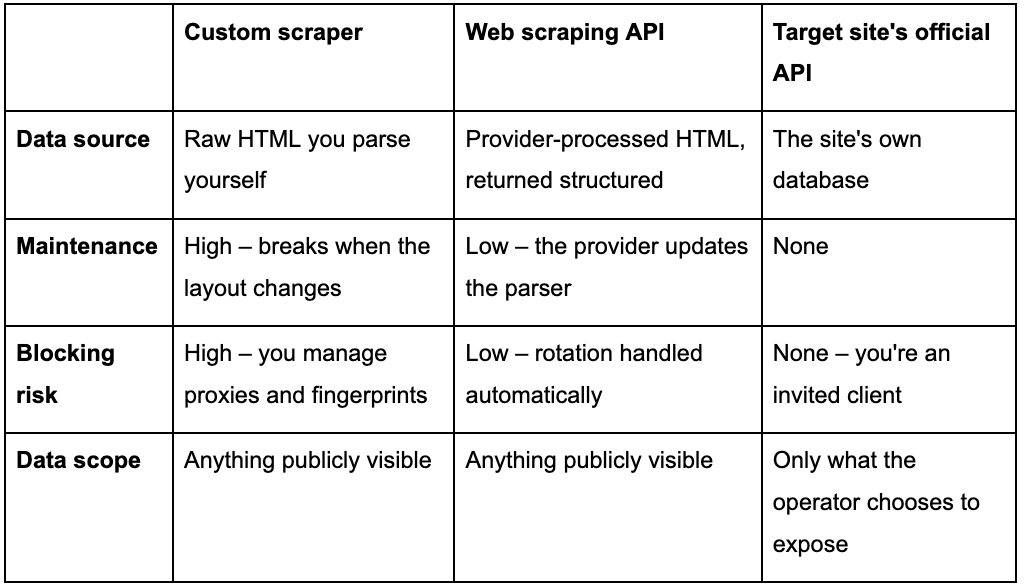
The official API wins on every axis except the one that usually decides it: scope. Most sites either don't offer one or expose a fraction of what's on the page. Custom scraping with Beautiful Soup remains the flexible option, at the cost of owning every failure yourself.
Scraping APIs cluster around four jobs.
Web scraping isn’t inherently illegal. Legality depends on how you access the data, what you collect, and how you use it afterward.
Scraping publicly visible, factual, non-personal data – prices, specifications, availability – is generally treated as lawful. In hiQ Labs v. LinkedIn, the Ninth Circuit held in 2022 that scraping publicly available pages likely doesn't violate the Computer Fraud and Abuse Act. Worth knowing, though, is that hiQ later lost on a separate claim: the court found it had breached LinkedIn's user agreement, and the case ended with an injunction against hiQ. The CFAA and contract questions are genuinely separate, and winning one doesn't settle the other.
Four things carry real risk:
This is informational, not legal counsel. A commercial project against a high-profile target warrants actual legal advice.
The providers most often named in this category – ScraperAPI, ScrapingBee, Firecrawl, Oxylabs, and Bright Data – all solve the same core problem: proxy rotation, JavaScript rendering, and anti-bot handling behind a single call.
GoProxies' scraping API does the same, with automatic IP rotation, JavaScript rendering, and CAPTCHA solving across an 80M+ IP network. The difference is what sits underneath it: the same residential proxy infrastructure powering GoProxies' other products, rather than a separately sourced pool.
Success rate still depends on the target site's defenses, request pattern, and rotation settings – no provider in this category can honestly promise otherwise.

Gintarė specializes in content related to proxies, web scraping, data collection, and internet infrastructure. With a solid background in information technology, networking, and cybersecurity, she understands both the technical and practical aspects of large-scale data acquisition.
The rich text element allows you to create and format headings, paragraphs, blockquotes, images, and video all in one place instead of having to add and format them individually. Just double-click and easily create content.
A rich text element can be used with static or dynamic content. For static content, just drop it into any page and begin editing. For dynamic content, add a rich text field to any collection and then connect a rich text element to that field in the settings panel. Voila!
Headings, paragraphs, blockquotes, figures, images, and figure captions can all be styled after a class is added to the rich text element using the "When inside of" nested selector system.




Common uses include e-commerce price and stock monitoring, collecting training data for AI models, aggregating market research data like job listings or reviews, and lead generation from public business directories. The shared thread is volume – each of these needs more pages than manual collection can reach.
No, not inherently. Legality depends on how you do it, what you collect, and how you use it. Scraping public, factual data is generally lawful, while bypassing logins, collecting personal data without consent, or republishing copyrighted content carries real legal risk.
Yes. GoProxies' scraping API is built on the same residential proxy network as its other products, and handles automatic IP rotation, JavaScript rendering, and CAPTCHA solving across an 80M+ IP pool.
Send an HTTP request with the target URL and your API key using the requests library, then parse the structured JSON response. Beautiful Soup and Selenium aren't needed for the extraction itself, since the API already handled that server-side.


