


A managed scraping API costs less to start and less to keep running; a custom scraper costs more of both but gives you complete control over parsing logic and per-request economics.
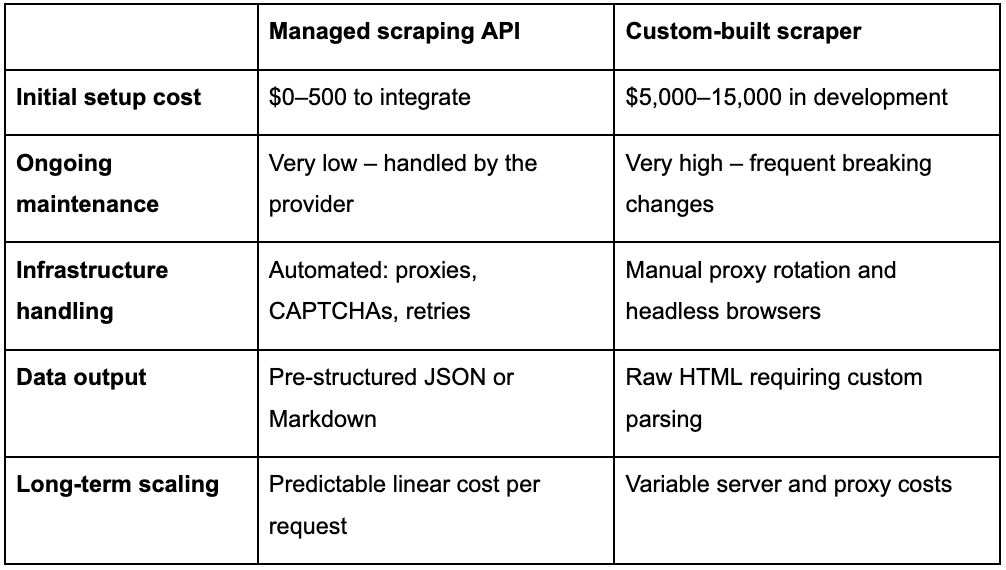
Those figures are industry-general estimates rather than a quote from any specific provider, and the build number varies enormously with target complexity. What doesn't vary is the shape: the API is cheap to start and predictable to scale; the custom build is expensive to start and unpredictable afterward.
For the definitional groundwork, see what a web scraping API actually does.
Managed APIs abstract away anti-bot defenses entirely – residential proxy rotation, header fingerprints, JavaScript rendering, and CAPTCHA solving all happen on the provider's side, invisible to your code.
Building your own scraper with Beautiful Soup, Puppeteer, or Selenium means constructing that same layer from scratch. The parsing logic is rarely the hard part. The proxy layer and server upkeep are consistently the largest source of silent operational failures in self-built scrapers, and "silent" is the operative word – a scraper that's been quietly returning empty results for three days doesn't announce itself; it just produces a dataset with a hole in it.
That's the real overhead. Not the initial build, which is a known quantity a competent engineer can scope, but the ongoing obligation to notice when something upstream changed.
A managed API converts that obligation into a line item. A custom scraper leaves it on your team, permanently, alongside whatever else they were hired to do.
Managed API endpoints stay stable even when a target site redesigns its front end, because the provider updates the underlying parser and your integration never notices.
DIY scrapers get no such shield. A layout change breaks CSS or XPath selectors immediately, and the failure mode is usually a scraper that still runs and still returns a 200, just with nothing useful in it. Teams frequently spend more engineering hours fixing broken scrapers than they spend using the data those scrapers were built to produce – which is a genuinely absurd ratio to discover you've been running for a year.
The debt compounds with target count. One scraper against one stable site is maintainable. Forty scrapers against forty sites that each redesign on their own schedule is a full-time role nobody budgeted for. That's the number worth modeling before committing to a build: not the cost of the first scraper, but the cost of the fortieth.
Managed APIs suit public data extraction – e-commerce pricing, search results, social trends, anything a logged-out visitor can see.
DIY scraping is still necessary when you need to navigate authenticated systems, internal enterprise portals, or session-state logic a standard API can't replicate.
This is exactly why Python teams doing complex authenticated work still reach for Selenium or Playwright over a managed service. Those tools hold a logged-in session and interact with a page the way a browser does, maintaining state across a multi-step flow that a stateless API call can't reproduce.
The opposite case is worth naming too. Amazon's own Selling Partner API is a good example of an official channel that covers a great deal of what teams would otherwise scrape. When a first-party API exists and exposes the fields you need, use it. Scraping around an available official API is effort spent solving a problem the site operator already solved for you.
Most production data pipelines aren't purely API or purely DIY, and the teams running them didn't arrive there by compromise – they arrived by noticing which targets cost the most to maintain.
The pattern that works: a managed scraping API for hardened, heavily protected, or rapidly changing targets, and custom scripts for simple static pages where per-request API costs would scale inefficiently. A static HTML page that publishes a CSV once a month doesn't need a managed service. A retail site running active bot detection and redesigning quarterly absolutely does.
Splitting the pipeline that way also clarifies choosing the right proxy setup, since the DIY half is the only part that needs its own proxy layer.
An API is an official channel. The site operator issues a key, you call a documented endpoint, and you receive structured data under an agreed contract. The format is stable because someone committed to keeping it stable, the rate limits are published, and access can include write operations as well as reads.
Web scraping extracts from whatever a site displays to a human visitor, with no such agreement. That makes it read-only by nature, less stable, since nobody promised the layout would hold, and legally more ambiguous, since no one granted you access in the first place. What scraping offers in exchange is scope: everything on the page, not just the fields an operator chose to expose.
Neither is the better option in the abstract. An official API is better when it covers what you need, and scraping exists because it usually doesn't.
Web scraping isn’t inherently illegal in the US. Legality depends on the type of data collected, how you access it, and what you use it for.
Extracting public facts, prices, or product information without a login is generally treated as lawful. In hiQ Labs v. LinkedIn, the Ninth Circuit held in 2022 that scraping publicly available pages likely doesn't violate the Computer Fraud and Abuse Act.
That holding is real, but the case is often cited more broadly than it supports: hiQ went on to lose on a separate breach-of-contract claim over LinkedIn's user agreement, and the matter ended with an injunction against hiQ. The CFAA question and the contract question are independent, and the outcome shows it.
The risk rises sharply with bypassed security or paywalls, personal data collected without consent under CCPA or GDPR, republished copyrighted creative content, or request volume heavy enough to degrade a server. Violating a site's terms of service is usually a civil breach-of-contract matter rather than a criminal one – which is a meaningful distinction, and also not the same as no consequence.
This is informational, not legal advice.
In the hybrid model above, GoProxies' scraping API is built to be the managed half – the part that absorbs the proxy rotation and infrastructure overhead described earlier, so in-house effort stays reserved for the authenticated and session-dependent work that genuinely requires it.
It handles automatic IP rotation, JavaScript rendering, and CAPTCHA solving across an 80M+ IP network. Success rate depends on the target site's defenses, request pattern, and rotation settings, as it does with any provider in this category.
Learn more about GoProxies' Scraping API here!

Gintarė specializes in content related to proxies, web scraping, data collection, and internet infrastructure. With a solid background in information technology, networking, and cybersecurity, she understands both the technical and practical aspects of large-scale data acquisition.
The rich text element allows you to create and format headings, paragraphs, blockquotes, images, and video all in one place instead of having to add and format them individually. Just double-click and easily create content.
A rich text element can be used with static or dynamic content. For static content, just drop it into any page and begin editing. For dynamic content, add a rich text field to any collection and then connect a rich text element to that field in the settings panel. Voila!
Headings, paragraphs, blockquotes, figures, images, and figure captions can all be styled after a class is added to the rich text element using the "When inside of" nested selector system.




Upfront, the API is typically $0–500 to integrate versus $5,000–15,000 in development. Long-term cost depends on volume: API pricing scales predictably per request, while a DIY scraper's maintenance cost is the variable that usually surprises teams.
When you need to navigate authenticated systems, internal enterprise portals, or session-state logic a standard scraping API can't replicate. Also, when the target is simple, static HTML, per-request API costs scale inefficiently.
An API is an official, documented channel: you get a key, call an endpoint, and receive structured data under an agreed contract. Web scraping extracts from what a site displays to human visitors, without that agreement, making it read-only, less stable, and more legally ambiguous.
No, not inherently. It depends on the data type, access method, and use. Public, non-personal data is generally lawful to collect, while bypassing security, gathering personal data without consent, or republishing copyrighted content carries real legal risk.


