


Google's Custom Search JSON API shuts down January 1st, 2027, and its official successor caps you at 50 domains per call. That's why most developers are already moving to one of three alternative categories, depending on whether they need Google-fidelity results, an independent index, or clean text for an LLM.
Google's Custom Search JSON API is already closed to new customers and shuts down entirely on January 1st, 2027.
Google points developers toward Vertex AI Search as the replacement, but it's a different product rather than a like-for-like successor. It's capped at searching 50 specified domains per call and doesn't return raw, unfiltered global web results the way the old API did. A Site Restricted variant of the old API still works, limited to ten or fewer specified sites.
So the honest answer to "is there an API for Google search?" is: not a straightforward, unrestricted one. Every remaining official route is scoped to a domain list, which is useful for site search and close to useless for anything that needs the open web. That gap is why a market of third-party alternatives exists, and why teams built on the JSON API are migrating rather than waiting.
These platforms scrape live Google results pages and return the data as structured JSON, automatically handling proxy rotation, CAPTCHAs, and geotargeting. Pick this category when you need what Google actually shows a user, in a specific location, right now.
The tradeoff shared across the category: you're dependent on someone else's ability to keep scraping Google successfully. That's a real operational dependency, and it's also precisely the work you'd otherwise be doing yourself.
These maintain their own web crawlers rather than scraping Google, which matters for teams who want to eliminate Google's infrastructure and policy risk rather than route around it.
The obvious cost is fidelity. An independent index isn’t Google's index, so results differ – sometimes usefully, sometimes not. If your application needs to reflect what a Google user sees, this category can't deliver that, and no amount of tuning changes it.
Standard search APIs return page metadata: titles, URLs, snippets. These return full readable page text instead, because an LLM's context window needs content rather than links.
If you're building an agent, start here rather than in the first category. Feeding raw SERP metadata into a context window and asking the model to work it out is a solved problem, and this is the solution.
Five providers across the three categories, on the dimensions that usually decide it.
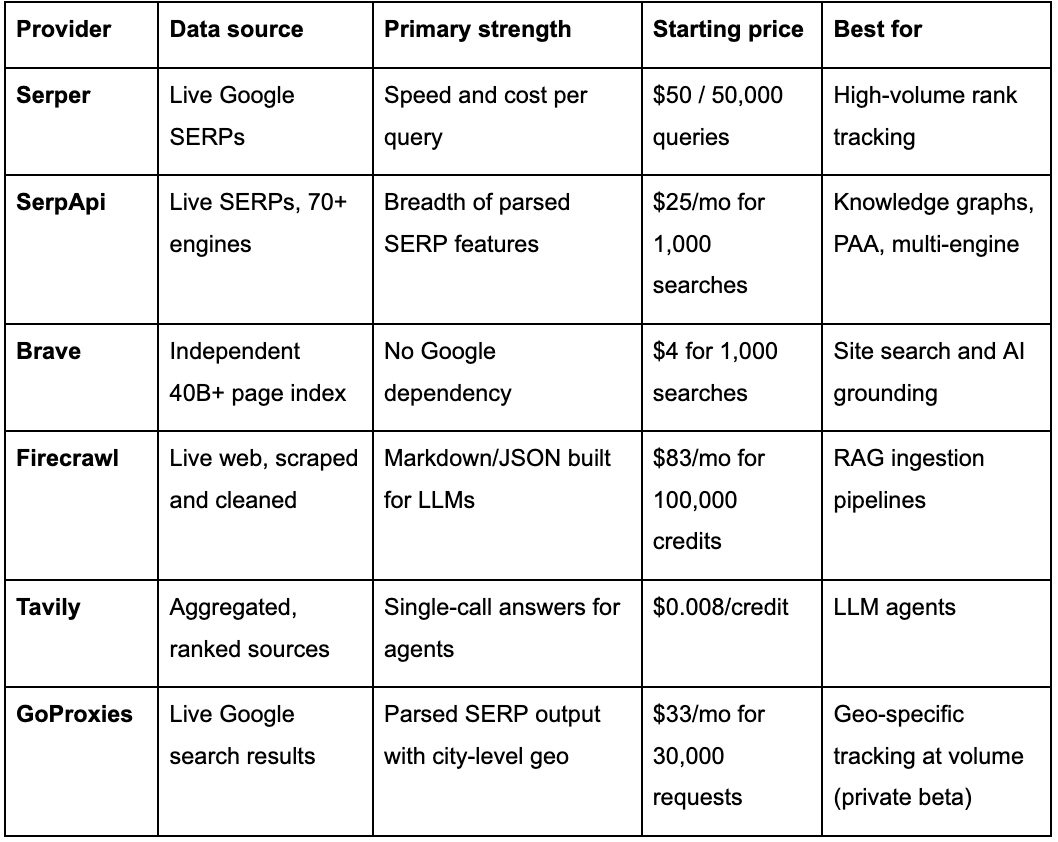
Google's own Custom Search JSON API offers 100 free queries per day, but it searches a specified site list rather than the open web, which makes it the wrong tool for most of what people want.
Third-party free tiers are the practical alternative:
No provider offers unlimited free Google search, and none will. Google now requires JavaScript to render results, which raised scraping costs enough that most developers stopped maintaining their own scrapers and started paying someone else to maintain one.
A free tier is an evaluation budget, not an operating model – useful for deciding whether a provider's output format fits your pipeline, and exhausted within a day of real use.
All of the above are managed services, and the tradeoff is the familiar one: less control, less maintenance.
Building your own Google Search scraper is still viable when volume or budget doesn't justify a subscription, or when you need control over parsing that no provider exposes. What it means in practice is solving the same problems these providers already solved – proxy rotation, JavaScript rendering, CAPTCHA handling – and then continuing to solve them every time Google changes something.
For the mechanics of the managed option, see our guide on what a web scraping API actually does. The decision usually comes down to whether scraping is your product or a dependency.
GoProxies covers both routes, which is unusual in this list.
For teams that want a managed SERP endpoint, GoProxies' scraping API includes a SERP product returning live Google search results, with targeting down to city level across 200+ locations. Output format depends on the response type: the lightweight, latency-optimized path returns parsed results ready to ingest, while richer response types – including AI-generated answers – come back unparsed for you to handle downstream.
For teams building their own scraper, the same residential proxy network underneath is available directly, which determines whether a self-built Google scraper survives contact with JavaScript rendering and anti-bot updates. Success rate depends on the target's defenses, request pattern, and rotation settings.
GoProxies' scraping API is currently in private beta.

Gintarė specializes in content related to proxies, web scraping, data collection, and internet infrastructure. With a solid background in information technology, networking, and cybersecurity, she understands both the technical and practical aspects of large-scale data acquisition.
The rich text element allows you to create and format headings, paragraphs, blockquotes, images, and video all in one place instead of having to add and format them individually. Just double-click and easily create content.
A rich text element can be used with static or dynamic content. For static content, just drop it into any page and begin editing. For dynamic content, add a rich text field to any collection and then connect a rich text element to that field in the settings panel. Voila!
Headings, paragraphs, blockquotes, figures, images, and figure captions can all be styled after a class is added to the rich text element using the "When inside of" nested selector system.





Google's Custom Search JSON API is closed to new customers and will be fully shut down on January 1st, 2027. Google's stated successor is Vertex AI Search, which is restricted to 50 domains per call rather than open web search, so it doesn't replace the old API's use case.
Serper currently offers the most generous free tier at 2,500 requests. Tavily provides 1,000 per month, and SerpApi provides 250 per month, with Serpstack at 100. No provider offers unlimited free Google search.
Yes. SearXNG is a self-hosted metasearch engine you can run via Docker, aggregating results across multiple engines. OpenSERP is a lightweight, self-hosted Go server that normalizes results from Google, Bing, and DuckDuckGo. Both require running your own infrastructure.
Tavily, Firecrawl, and Exa are built specifically for LLM and RAG use cases. They return full, readable page text rather than metadata alone, which is what an agent's context window actually needs to reason over.


