
Back

How Much More Do Gamers Pay Around the World? A 30-Country Steam Price Analysis

An image of a gamer's desk and a game console in the center

How Much More Do Gamers Pay Around the World? A 30-Country Steam Price Analysis

An image of a gamer's desk and a game console in the center

Unlike physical goods, digital products don’t suffer from dynamic shipping costs, raw material sourcing, or warehouse logistics, but their prices vary wildly across the globe. We decided to take a look at how much of a “geo-tax” gamers face depending on their location.

Using GoProxies' rotating residential proxies targeting 30 countries, our researchers visited the Steam store page for six popular AAA titles (high-budget, blockbuster video games developed and published by large studios) and recorded the listed price for each location. 

They then converted all prices to USD using a single FX (foreign exchange) rate snapshot from April 13th, 2026, to ensure a fair comparison.

The Games We Tested

Our researchers selected six popular titles spanning different publishers, genres, and price points. Five of them share the same $59.99 US base price, making our cross-country comparison particularly clean:

Table with information on the six games tested

The Cheapest and Most Expensive Countries

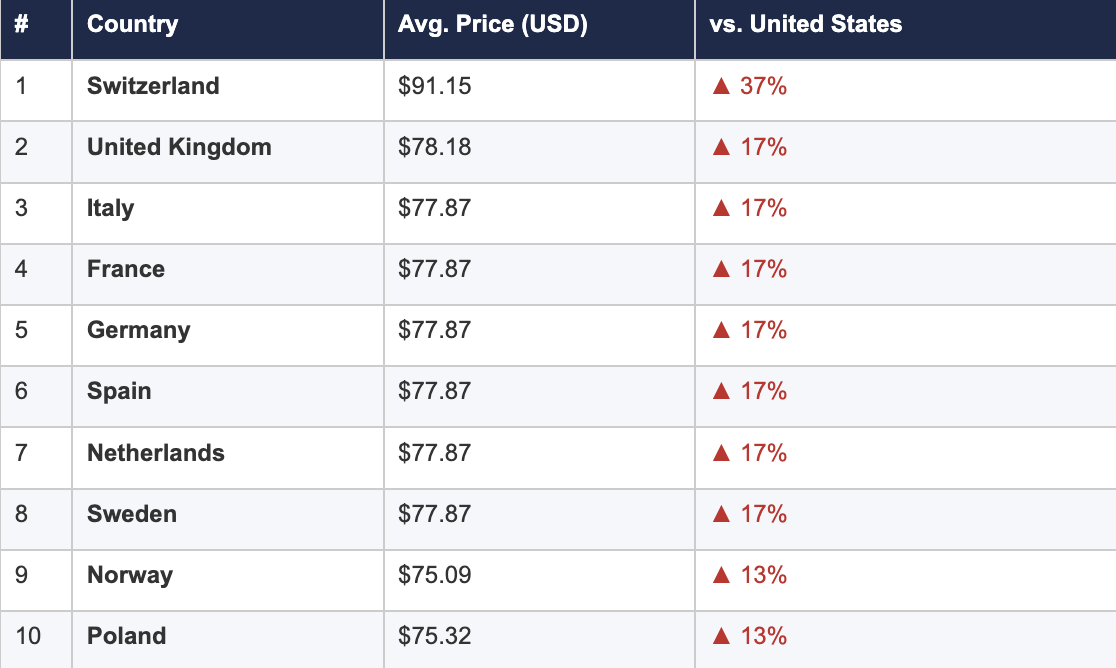
Across all six titles, the average game price ranges from $36.30 in the cheapest country to a staggering $91.15 in the most expensive – a 151% difference for identical products.

Top 10 Cheapest Countries

Table of top ten cheapest countries

Top 10 Most Expensive Countries

Table of the top ten most expensive countries

The United States itself lands right in the middle of the pack, averaging $66.66.

Regional Breakdown

  • Asia is the cheapest region overall, averaging $56.02 per game – 16% less than the US price. India and Indonesia lead with particularly aggressive regional pricing, likely reflecting adjustments in purchasing power. South Korea, Japan, and Singapore all sit closer to the US price point.
  • Latin America averages $59.91, roughly 10% cheaper than in the US. Gamers in Brazil, Chile, and Colombia all benefit from regional pricing, though Mexico often charges a few dollars more than the US.
  • Europe is consistently more expensive than the US. The EU block (Germany, France, Italy, Spain, Netherlands, Sweden) all share the same Euro-denominated pricetag, which converts to roughly $77.87 – a 17% premium over the US. Switzerland tops the charts globally at $91.15, 37% more than gamers in the US would pay.

Game-by-Game Highlights

Let’s take a look at the breakdown of a few games' price variations.

Baldur’s Gate 3: Widest Price Spread (241%)

Baldur’s Gate 3 showed the widest price variation. Russian gamers wanting to play the role-playing game had to pay just $25.92. A few thousand miles away, Swiss gamers had to hand over $88.26 – that’s 241% more money for the exact same game.

Baldur’s Gate 3 price breakdown globally

Civilization VII: Premium Title, Bigger Gaps

As the only $99.99 title in our set, the turn-based strategy game, Civilization VII, amplifies the regional differences. Indian gamers pay $61.17 – a 39% discount compared to the US – while Swiss gamers pay $125.98, a 26% premium.

Red Dead Redemption 2: Narrowest Spread (63%)

Red Dead Redemption 2, the action game based in the fictional version of the Wild West, showed the tightest pricing: only a 63% spread from South Korea’s $49.20 to the UK’s $80.42. 

The majority of the 30 countries tested clustered in the $55–70 range, suggesting that Rockstar Games uses a narrower regional pricing band than other publishers.

The EU “Geo-Tax”

One of the most consistent patterns in our data is that every EU country charges the same Euro-denominated price. For a $59.99 US game, the EU price is €59.99. This may sound like equality, but after converting the price to USD, that’s roughly $70.08, or a 17% markup.

This isn’t a case of currency fluctuation. Video game publishers deliberately set the nominal Euro price equal to the Dollar price, even though the Euro is worth more than the Dollar. As a result, 450 million EU gamers systematically pay a hidden premium every time they buy a game on Steam.

Region Locks and Anomalies

  • Russia: Four out of the six tested games (Cyberpunk 2077, Red Dead Redemption 2, Civilization VII, Hogwarts Legacy) are region-locked and unavailable here. Only Elden Ring and Baldur’s Gate 3 remained accessible and showed the lowest global prices.
  • Turkey: While most countries see prices in their local currency, Steam displays prices in USD for Turkish gamers. Elden Ring shows a “$39.99 USD” price tag instead of using the Turkish Lira. Turkish gamers get a direct USD discount (33% off the US price), but miss out on local-currency purchasing-power adjustments.

Key Takeaways

  • Where you live determines what you pay. The same $59.99 game costs anywhere from $25.92 to $88.26, depending on your country – a 241% difference.
  • European gamers pay a consistent 17% premium over US gamers, driven by nominal currency-parity pricing (€59.99 = $59.99 despite exchange rate differences).
  • Asia and Latin America benefit the most from regional pricing differences, with India, Indonesia, and the Philippines getting the largest discounts (25–46% below US prices).
  • Switzerland is the most expensive country for gaming across every title we tested, averaging 37% above US prices.
  • Russian gamers pay the lowest prices but also face significant region locks, with four out of the six tested games unavailable in the country.
  • Publisher strategies vary. Rockstar Games (RDR2) uses narrow price bands (63% spread), while Larian (BG3) allows much wider regional variation (241%).

Methodology

  • Data collection date: April 13th, 2026.
  • Proxy setup: GoProxies rotating residential proxies with country-level targeting to simulate a real user visiting the Steam store from each country. Residential IPs are essential, as datacenter IPs are frequently detected and blocked, which would skew results.
  • Price extraction: The prices were extracted from server-side rendered HTML using the parser, BeautifulSoup. Steam renders prices server-side, meaning no JavaScript rendering or browser automation was required.
  • Currency conversion: All local prices were converted to USD using a single FX rate snapshot taken at the time of data collection, April 13th, 2026, ensuring consistent cross-country comparisons without intraday fluctuation artifacts.
  • Limitations: This study captures list prices only, so it doesn’t account for available regional sales, bundle discounts, or promotional pricing. Steam prices can change suddenly and without notice.

GoProxies Research Team is a group of analysts and writers focused on web data, online privacy, and proxy technology. They produce practical, research-backed content that helps readers understand digital trends, tools, and best practices.

Turn data insights into growth with GoProxies
Millions of IPs are just a click away!

What’s a Rich Text element?

The rich text element allows you to create and format headings, paragraphs, blockquotes, images, and video all in one place instead of having to add and format them individually. Just double-click and easily create content.

Static and dynamic content editing

A rich text element can be used with static or dynamic content. For static content, just drop it into any page and begin editing. For dynamic content, add a rich text field to any collection and then connect a rich text element to that field in the settings panel. Voila!

How to customize formatting for each rich text

Headings, paragraphs, blockquotes, figures, images, and figure captions can all be styled after a class is added to the rich text element using the "When inside of" nested selector system.

FAQ

What Are Rotating Residential Proxies?
Rotating Residential Proxies offer you the best solution for scaling your scraping without getting blocked.

Rotating proxies provide a different IP each time you make a request. With this automated rotation of IPs, you get unlimited scraping without any detection. It provides an extra layer of anonymity and security for higher-demand web scraping needs.

IP addresses change automatically, so after the initial set up you’re ready to scrape as long and much as you need. IPs may shift after a few hours, a few minutes or after each session depending on your configuration. We do this by pulling legitimate residential IPs from our pool.
Why Do You Need Rotating Residential Proxies?
There are a number of use cases for rotating residential proxies. One of the most common ones is bypassing access limitations.

Some websites have specific measures in place to block IP access after a certain number of requests over an extended period of time.

This limits your activity and hinders scalability. With rotating residential IP addresses, it's almost impossible for websites to detect that you are the same user, so you can continue scraping with ease.
When to Use Static Residential Proxies Instead?
There are particular cases where static residential proxies may be more useful for your needs, such as accessing services that require logins.

Rotating IPs might lead to sites not functioning well if they are more optimised for regular use from a single IP.

Learn if our static residential proxies are a better fit for your needs.
Can I choose the IP location by city?
Yes. GoProxies has IPs spread across almost every country and city worldwide.
Can I choose the IP location by country state?
Yes. GoProxies has IPs spread across X countries with localised IPs in every state.